

 Português
  Español
  English
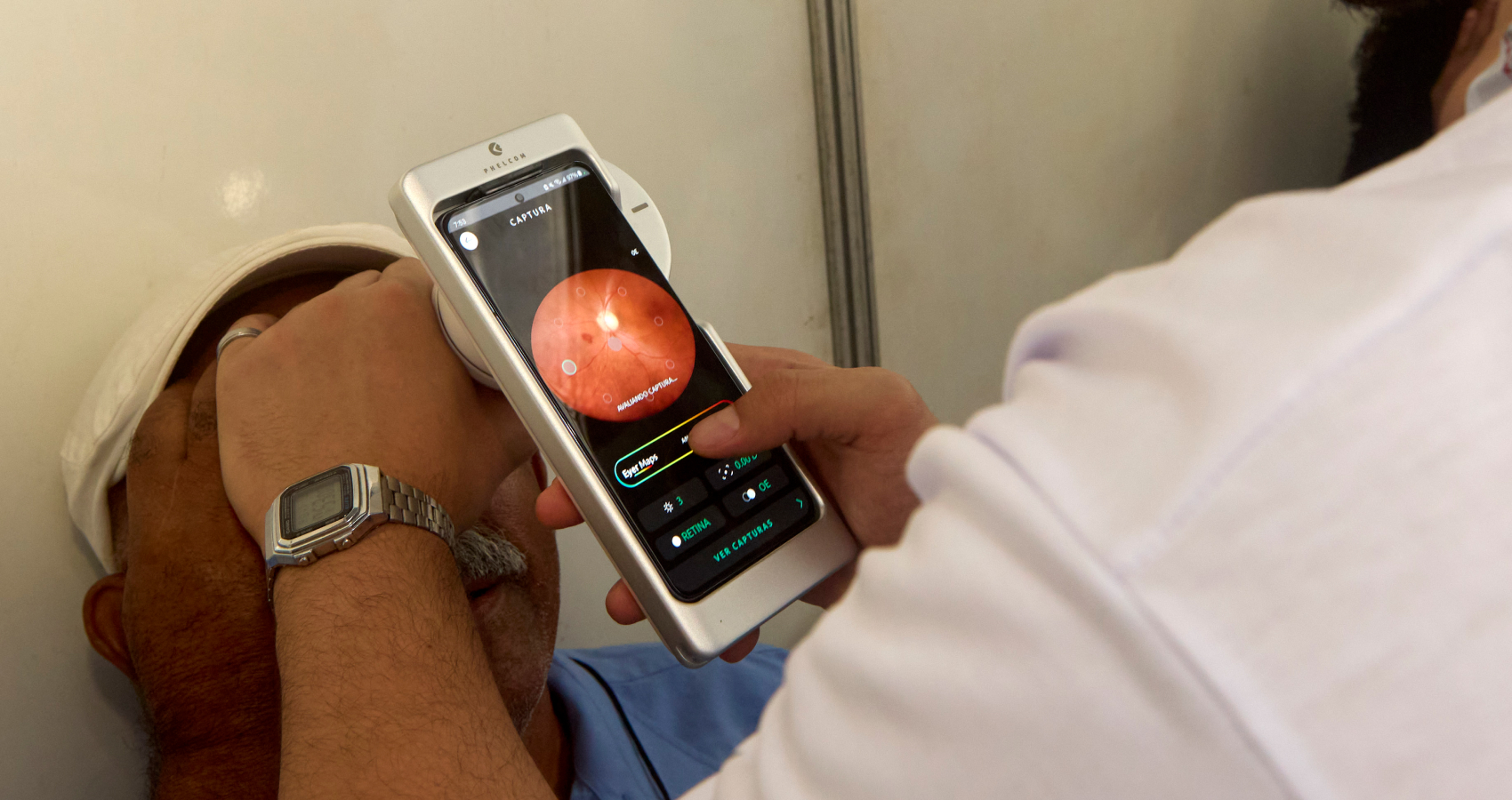
Beyond its role in daily clinical workflows, the Eyer handheld fundus camera and EyerMaps Artificial Intelligence have become instrumental in advancing global ophthalmic research. Recently, two landmark studies were selected for presentation at the world’s most prestigious vision research conference: The Association for Research in Vision and Ophthalmology (ARVO). Notably, one of these studies also received the “Best Paper” award at the Association of University Professors of Ophthalmology (AUPO) annual meeting.
Eyer’s Artificial Intelligence in the Real World
The paper “Real-world performance of an offline, automatic algorithm for diabetic retinopathy detection embedded in a handheld smartphone-based retinal camera on two ethnically diverse populations,” led by Dr. Fernando Malerbi, evaluated Eyer’s offline AI for Diabetic Retinopathy (DR) screening in challenging, real-world environments. The study will be presented on May 3, 2026.
Overcoming Algorithmic Bias
For AI to be truly effective, it must perform reliably across all demographics, not just in a controlled lab setting. “In addition to the initial tests we perform to verify if the algorithm provides correct answers, it is crucial to reproduce them in populations with different characteristics—for example, in our study, with diverse ethnic backgrounds. This ensures representativeness in the database, optimizes the tool’s performance, and mitigates the risk of it succeeding in one scenario but failing in another,” explains Dr. Malerbi.
To prove this robustness, the study analyzed retinal images from 1,257 diabetic patients across two demographically distinct Brazilian regions:
- Itabuna (Bahia): A population predominantly of African descent, characterized by a higher prevalence of DR and shorter diabetes duration.
- Blumenau (Santa Catarina): A population predominantly of European descent.
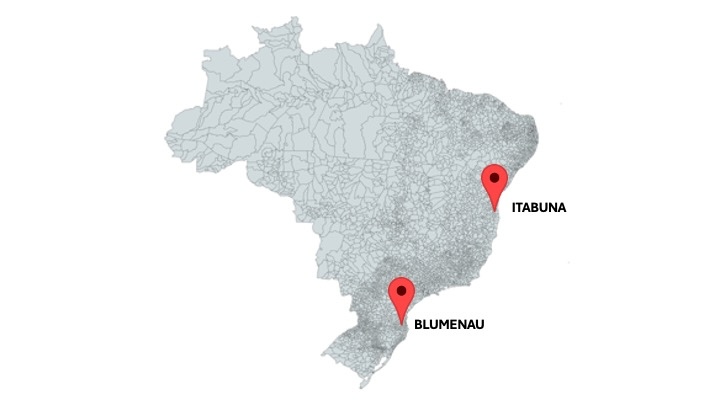
Map highlighting Itabuna and Blumenau, the cities where patient samples were collected.
Professional Results in the Hands of Volunteers
A key differentiator of this study was that image acquisition was performed largely by non-medical volunteers with varying experience levels during high-volume screening events.
Even without specialized medical training, the results were impressive. “The relevance of this study also lies in its excellent accuracy metrics and image quality. In more than 90% of the cases, it was possible to acquire adequate, high-quality images,” notes Dr. Malerbi. He attributes this success to Eyer’s intuitive design, which simplifies framing, lighting, and focus.
The study confirmed that Eyer’s AI is accurate, consistent, and free of geographic or ethnic bias, demonstratimg that low-cost, user-friendly devices can play a massive role in preventing global blindness.
The Technical Challenge: AI at the Edge
For Paulo Prado, Phelcom’s AI and Mobile Software Coordinator, the project was a masterclass in engineering with a purpose. “Participating in this project was a very meaningful experience, connecting my background directly to people’s health. One of the most important aspects was developing an algorithm capable of running offline and embedded in the device without compromising accuracy, which posed a massive technical challenge,” Prado reports.
Prado reinforces that sample diversity was crucial to validate the engineering team’s work. “Validating the system across two such distinct populations demonstrates its robustness in real-world scenarios and helps ensure the technology is truly useful in clinical practice. For me, it was incredibly rewarding to contribute to a solution that aids in the early detection of diabetic retinopathy, expanding access to disease screening, especially in areas with less medical infrastructure.”
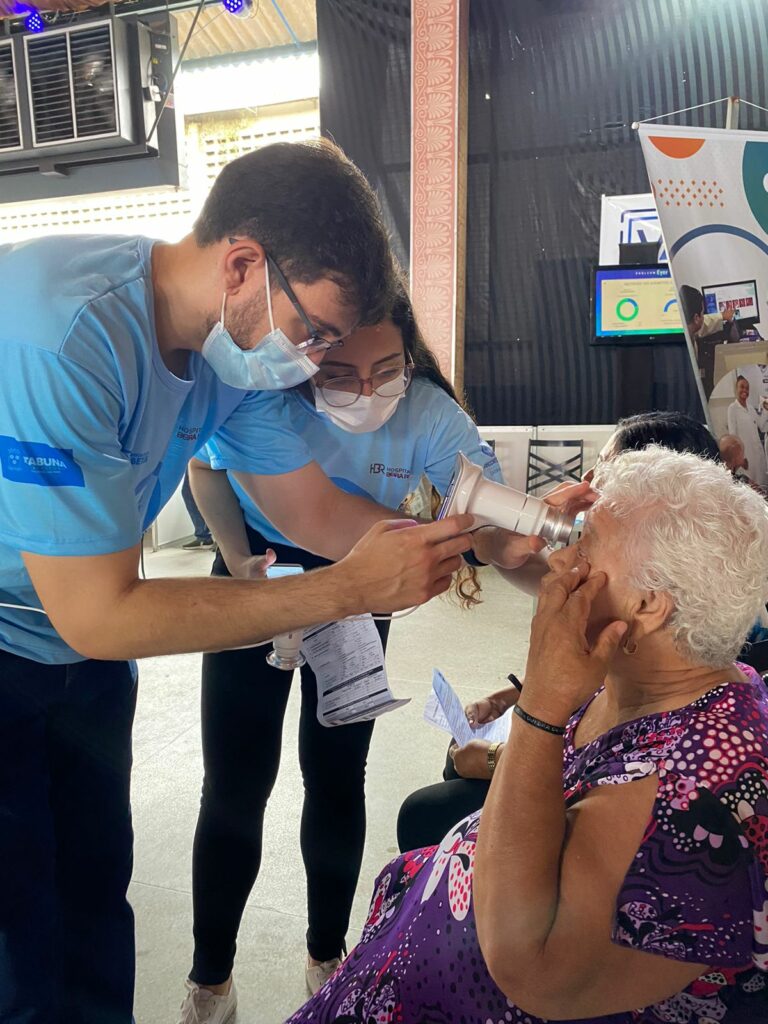
Paulo Prado taking a retinal image with Eyer during the Diabetic Retinopathy Screening Event in Itabuna, 2022.
Eyer at the Bedside: Top Honors at AUPO
A second study, “Handheld Non-Mydriatic Fundus Camera for Bedside Inpatient Ophthalmology and Neurology Consultations,” led by neuro-ophthalmology specialist Dr. Valerie Biousse and researchers at Emory University, highlighted Eyer’s utility in hospital settings.
In scenarios where transporting patients to traditional tabletop devices is impossible, Eyer’s portability allowed for rapid, accurate bedside diagnoses. The clinical impact was so profound that the study was named Best Paper at the AUPO conference.
Shaping the Future of Precision Ophthalmology
The 2026 ARVO Annual Meeting centers on the theme: “Achieving precision ophthalmology through innovative vision research,” a topic thoroughly aligned with the studies conducted using Eyer. The meeting will take place from May 3 to May 7, 2026.
“This event is considered the largest and most important scientific meeting for ophthalmology and visual science research in the world,” Dr. Malerbi summarizes. “It is where the main ideas are presented and validated. Solutions that will enter the market or become available as treatments in the future are presented at ARVO. It inherently carries this pioneering character.”
For Phelcom, having Eyer validated in these studies proves the company’s alignment with the future of global “precision ophthalmology.” As Dr. Malerbi concludes: “It is truly important to be present at this event, both from the perspective of a scientific author and that of a company with such robust research and development.”
Diego Lencione, Co-founder and CTO of Phelcom, sees these accolades as a sign of the company’s maturity. “It is incredible to witness the evolution of Phelcom’s products and our growing relevance on the international stage. In recent years, we have achieved FDA regulatory clearance for our products, and year after year, we see our presence expanding in the global market. Undoubtedly, part of this success stems from our efforts and investments in Research and Development, which culminate in this highly relevant work to be presented at ARVO 2026, combining our expertise in the design and manufacturing of ophthalmic devices and artificial intelligence solutions that truly add value for doctors, patients, and society as a whole.”
About Phelcom
Phelcom Technologies is an American-Brazilian company that employs Physics, Electronics, and Computing to make visual health simpler, more connected, and smart.
Founded in 2016 by three young researchers: José Augusto Stuchi, a computer engineer; Flavio Pascoal Vieira, an electronic engineer; and Diego Lencione, a physicist. Inspired by co-founder Diego’s brother, who had struggled with a severe vision condition since childhood, the three founders set out to develop a portable retinal camera with an integrated smartphone.
In 2019, Phelcom launched its first product, the Eyer, a portable retinal camera. Five years later, the company introduced the Eyer2, a photo documentation platform capable of capturing high-quality images of both the posterior and anterior segments.
Today, with 10 years of history, Phelcom’s technology has benefited over two million people across multiple countries, including the United States, Japan, Chile, Colombia, the United Arab Emirates and Brazil. It has also been used in over 200 social outreach initiatives.


